THE SPECIALTY ITEM KINGS OF TEXAS
Safe Movers — Residential and Commercial Safe Relocations
For homeowners and businesses across Texas with a safe other movers won't touch — fire safes, jewelry safes, restaurant cash safes, gun safes, dispensary vaults, and full commercial vault doors.
By the numbers
2,200+
Five-Star Reviews
6
Texas Locations
7 yr
Avg. Mover Tenure
Same-Day
Written Estimate
What this looks like
The operational reality.
A safe move is a structural problem first and a security problem second. The structural problem is weight: a small residential fire safe is 150 lbs, a mid-size home safe runs 300–800 lbs, a commercial cash safe sits in the 800–2,500 lb range, and a vault door alone can run 3,000–5,000 lbs. That weight has to travel down a hallway, across a floor that may not be rated for it, possibly down or up stairs, into a truck, across town, and into the new location — without cracking tile, gouging hardwood, breaching the safe's fire rating, or hurting a crew member.
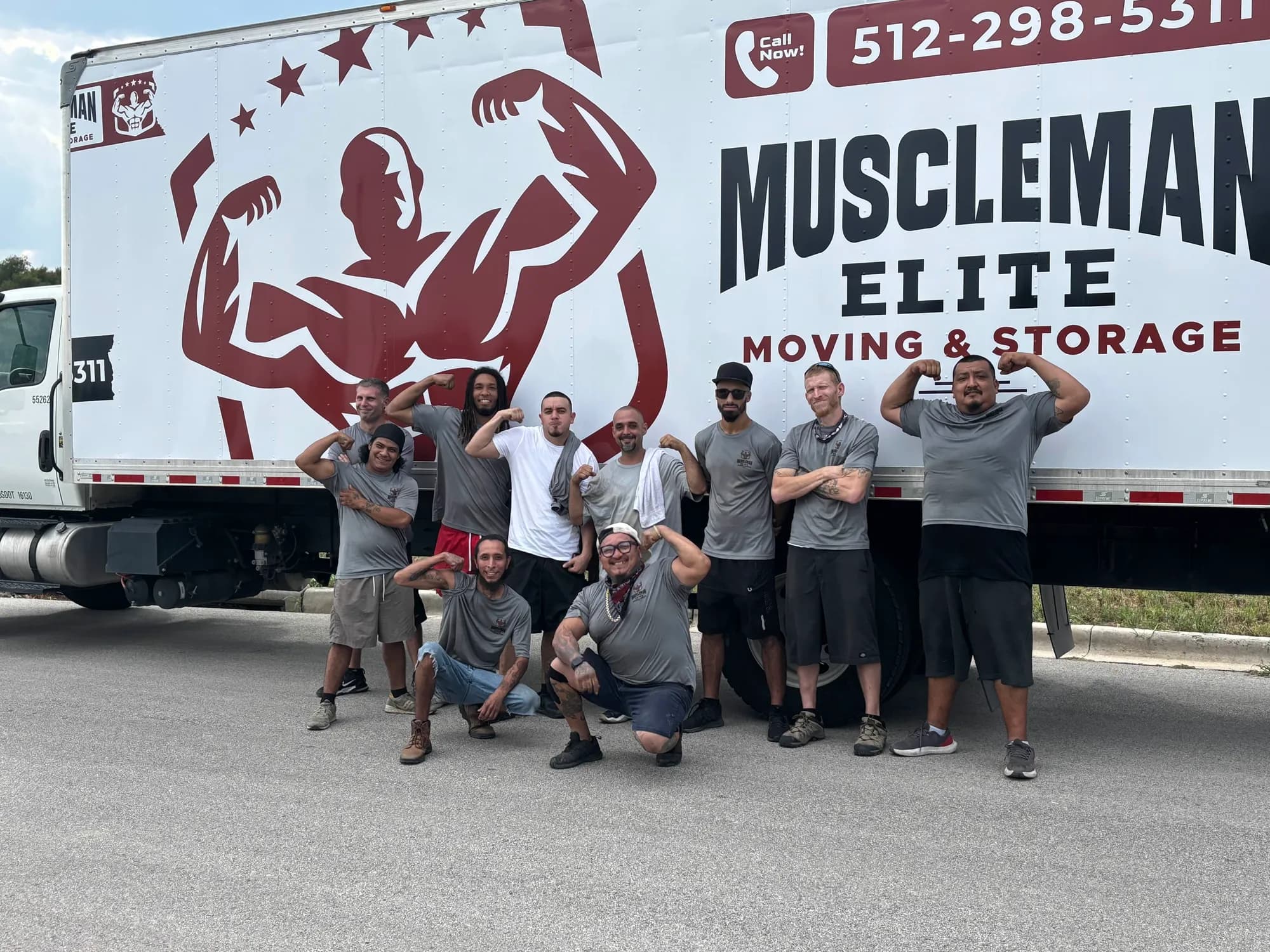
Muscleman Elite moves safes for residential customers (gun safes, fire safes, jewelry safes, document safes), commercial customers (restaurant cash safes, dispensary safes, jewelry-store display safes, pharmacy controlled-substance safes), and bank or building-management clients (full vault doors, ATM-class safes). We do not crack safes, repair locks, or change combinations — those are locksmith and safe technician services.
What makes this hard
Not a generic move.
Floor load and route evaluation comes before anything else. A 1,200-lb safe sitting on a slab garage floor is one problem. The same safe on the second floor of a wood-frame home with a wood-joist subfloor is a different problem entirely — the floor may not be rated for that point load, and even if it is, the route to the staircase crosses tile that cracks at 800 lbs of point pressure. Standard movers either refuse the job at this point or, worse, take it without doing the math and crack the floor. We evaluate the route — slab-on-grade vs. pier-and-beam vs. second-floor wood frame, threshold heights, tile vs. hardwood vs. carpet, stair pitch, landing turns — before we quote.
Stairs are where bad safe moves go to fail. A safe going down a flight of stairs has the entire weight pulling toward the lead carrier. A safe going up amplifies the muscle problem and the risk of the safe slipping back. Both directions require climbing dollies rated for the weight class, a controlled-descent strap system on heavy units, and crew sized to the load — never two people on a 600-lb safe.
Why standard movers refuse the job. Most local moving companies don't carry the right gear for safes over 300 lbs. They don't own the heavy climbing dollies, the controlled-descent rigging, or the steel toe-jack systems. Their insurance often excludes safes over a weight threshold. So the call goes to us. The phrase we hear from customers repeatedly: *"Three other movers said they wouldn't touch it."*
The commercial-cash-safe variant. Restaurant cash safes, dispensary safes, and dispensary vault rooms bring their own complications: cash inside that the owner has to clear before move day, drop-slot mechanisms that pinch hands, and floor-bolted installations that have to be unbolted (and often re-bolted at the new location) with the right hardware.
“The moves other movers refer out — pianos, gun safes, hot tubs, antiques, fragile lab equipment. Those are our standard jobs.”
— Mike Stackable, Founder
How we handle it
The process.
1. The pre-move site visit or photo review. For any safe over 500 lbs, we strongly prefer an in-person walkthrough. The move planner measures the safe, asks the manufacturer and model (so we can look up the actual weight and dimensions), evaluates the route at both ends, checks floor surfaces and stair geometry, and flags anything that needs to be addressed before move day — like a doorway that has to come off its hinges, or a floor that needs plywood protection laid down.
2. The written estimate with weight class and gear list. Items in the 300–500 lb class are quoted at $300 flat solo or $200 bundled with a move. 501–800 lbs at $0.75/lb solo or $0.50/lb bundled. 801–1,000 lbs at $1.00/lb solo or $0.70/lb bundled. 1,001–1,500 lbs at $1.25/lb solo or $1.00/lb bundled. Above 1,500 lbs is call-for-quote. Stair fees apply per step. The estimate also lists the gear we're bringing — climbing dollies, steel toe jack, controlled-descent straps, padded blankets, plywood floor runners, and any specialized rigging.
3. The crew sizing. Two-person for sub-300-lb residential fire safes on a single level. Three-person for 300–800 lb safes with stair work. Four-person for anything over 800 lbs or any commercial cash safe with floor anchors. The job is sized to the load — we do not muscle safes with under-crewed teams.
4. Floor and route protection. Plywood runners across tile, hardwood, and luxury vinyl plank. Carpet film over carpet runs. Threshold ramps where threshold heights are significant. Wall corner protection on tight stairwells.
5. The lift, the route, and the descent. Climbing dolly under the safe, two crew on the strap system above (for descents) or three crew on the push side (for ascents). Controlled-descent rigging on heavier units — never freewheel on a dolly down a staircase. Constant communication in the staircase, with the lead carrier calling the steps.
6. The truck load and securement. Safe goes on the truck floor, not on a furniture-level platform. Strapped to the wall studs of the truck at three or more points. Padded blankets on every contact surface.
7. The placement at the new location. Same route protection in reverse. Safe positioned to within an inch of the customer's specified location. We don't bolt safes to floors as a default — that's a locksmith or safe technician scope and usually requires a tap-on-the-anchor concrete bit work that we'll coordinate but not perform. For commercial safes that came bolted, we'll unbolt at pickup and have your locksmith on call for the re-bolt at the destination.
8. The post-move walkthrough. Floor condition checked. Safe placement confirmed. Combination test optional (customer-performed; we don't touch the lock).
Pricing factors
What moves the number.
- 01
Weight
The primary driver. The specialty pricing covers the 300+ lb range. Items under 300 lbs (small fire safes, small jewelry safes) are typically bundled into a household move at standard hourly rates.
- 02
Stairs
Each step adds to the labor. Stair fees: $10 per step up / $5 per step down for 300–500 lb items, scaling up to $20/$15 per step for items in the 1,001–1,500 lb range.
- 03
Turn and landing fees
Staircases with intermediate landings or 90° turns add a per-landing fee on heavier safes ($50 to $150 depending on weight class).
- 04
Floor protection scope
A large multi-room residential job or a commercial restaurant move with tile flooring throughout requires extensive plywood runners. Materials and setup labor are itemized.
- 05
Hoisting or crane
If the safe is going to a second-floor location with no stair option, we hoist or crane — quoted per job.
- 06
Distance
Local moves are hourly with a 2-hour minimum, prorated in 15-minute increments. Long-distance is flat-rate.
- 07
Locksmith or safe technician coordination
We don't bolt-anchor, drill, or open safes. If your move requires those services on either end, we'll coordinate timing with your locksmith but those are separate scopes and separate invoices.
Customers may choose from valuation and additional-coverage options during booking. For separate moving insurance, customers can purchase coverage through third-party providers such as movinginsurance.com.
Common scenarios
What we actually see.
- 01
Home fire safe, ground floor to ground floor.
250 lb fire safe in a master closet, two-person crew with a climbing dolly, plywood across tile, bundled into a household move.
- 02
Heavy gun safe, second-floor bedroom to garage.
1,200 lb gun safe going down a wood staircase with one landing turn. Four-person crew, controlled-descent rigging, plywood floor protection. Quoted as a standalone specialty job at the 1,001–1,500 lb tier.
- 03
Restaurant cash safe relocation.
800 lb floor-bolted cash safe, unbolt at the old location, transport to the new restaurant, locksmith on call to re-anchor at the new spot. After-hours move to avoid disrupting business.
- 04
Dispensary vault door swap.
3,000+ lb vault door, call-for-quote, project-managed with the dispensary's compliance officer, COI for the building, after-hours window.
- 05
Jewelry store safe upgrade.
Old display safe out, new display safe in, same day, security personnel present for the cash and inventory portion (handled separately by the store before we arrive).
- 06
Long-distance safe move, Austin to Odessa.
600-lb home safe, crated for the longer transit, flat-rate quote, two-person crew on each end.
Where we run this
Across Texas.
Muscleman Elite moves safes across the full Austin metro and the Permian Basin from six Texas locations: downtown Austin headquarters (823 Congress Ave), North Austin/Domain (7218 McNeil Dr), Lakeway/Bee Cave (15201 Dexler Dr), Dripping Springs/Wimberley (12700 Daniel Boone Dr), Buda/Kyle (3921 Dacy Ln), and Midland (601 N Marienfeld St) for the Midland/Odessa Permian Basin market.
Residential safe demand concentrates in the estate markets (Westlake, Barton Creek, Tarrytown, Lakeway, Bee Cave) and in the Hill Country ranch market where gun safes are common. Commercial safe demand sits with the downtown restaurant scene, the East Austin and South Austin dispensary cluster, the Domain retail jewelry stores, and the Permian Basin oilfield service offices and bank branches.
Questions we get
About this move type.
- Why do other movers refuse to move safes?
- Most local movers don't carry the gear or the insurance posture for safes over a few hundred pounds. The climbing dollies, controlled-descent rigging, and crew sizing required for an 800-lb safe down a flight of stairs aren't standard for a generic household move. Their cargo coverage often excludes safes above a weight threshold. So the call comes to us. We've heard "three other movers said they wouldn't touch it" enough times that it's become part of why we're the Specialty Item Kings of Texas.
- Do you move loaded gun safes?
- We strongly recommend the safe be emptied before move day — both for weight reduction (firearms, ammunition, and contents can add 100+ lbs) and for liability. If a customer prefers to move the safe with contents inside, we'll do the move provided the contents are secured, the safe is fully locked, and the customer signs an acknowledgment that we don't inspect or inventory contents. We never transport loose firearms or ammunition outside a locked safe.
- Will you bolt the safe down at the new location?
- No — anchoring a safe to a concrete or wood floor is a locksmith or safe technician scope and often requires hammer drilling into slab, masonry anchors rated to the safe's specification, and sometimes a tamper-evident installation procedure. We coordinate timing with your locksmith but the actual anchor installation is their work. Same logic applies to safes that came bolted from the original location — we unbolt to move, your locksmith re-bolts at the destination.
- Can you move a safe up or down stairs?
- Yes — most of our safe moves involve stairs. We use climbing dollies rated for the weight class, controlled-descent strap systems on heavier units, and crew sized to the load. For anything over 800 lbs going through a stairwell, we walk the route first, measure the landings, confirm the stair pitch will accommodate the dolly, and only proceed when the geometry checks out. If a stairwell can't physically accommodate the safe, we tell you on the walkthrough and propose a hoist alternative.
- Do you move commercial restaurant or dispensary safes?
- Yes. Restaurant cash safes, dispensary product and cash safes, pharmacy controlled-substance safes, and jewelry-store display safes are all in our wheelhouse. These moves usually happen after-hours to avoid disrupting business and require the customer to clear cash and inventory before we arrive. We coordinate with the locksmith for unbolt and re-bolt on each end. COIs available in 24-48 hours from the building's underwriting requirements.
- What about full vault doors — bank vaults, dispensary vault rooms?
- Vault doors are project work. They typically weigh 2,500–5,000+ lbs, require coordinated rigging often involving a forklift or telehandler on the loading end, and have to be transported on a flatbed or in a dedicated truck. We've moved them. Call for quote on anything above 1,500 lbs — these jobs are scoped individually rather than priced from the standard specialty pricing.
- Are you licensed and insured for commercial safe relocation?
- Yes — USDOT 2105156, TxDMV 006568203C, with general liability, cargo, and workers' compensation coverage that meets standard commercial building requirements. COIs typically issued within 24-48 hours of the building's underwriting documents reaching us. For separate moving insurance on high-value safes or contents, customers can purchase coverage through third-party providers such as movinginsurance.com.
Ready to book?
Tell us the date.
Send us a photo of the safe with a tape measure for scale, the manufacturer and model if visible, and the access at both ends (stairs, doorway widths, floor surface). We'll come back with a written estimate, the gear list, and the crew size. Send photos for a fast quote — or talk to a move planner for anything over 800 lbs or any commercial install.